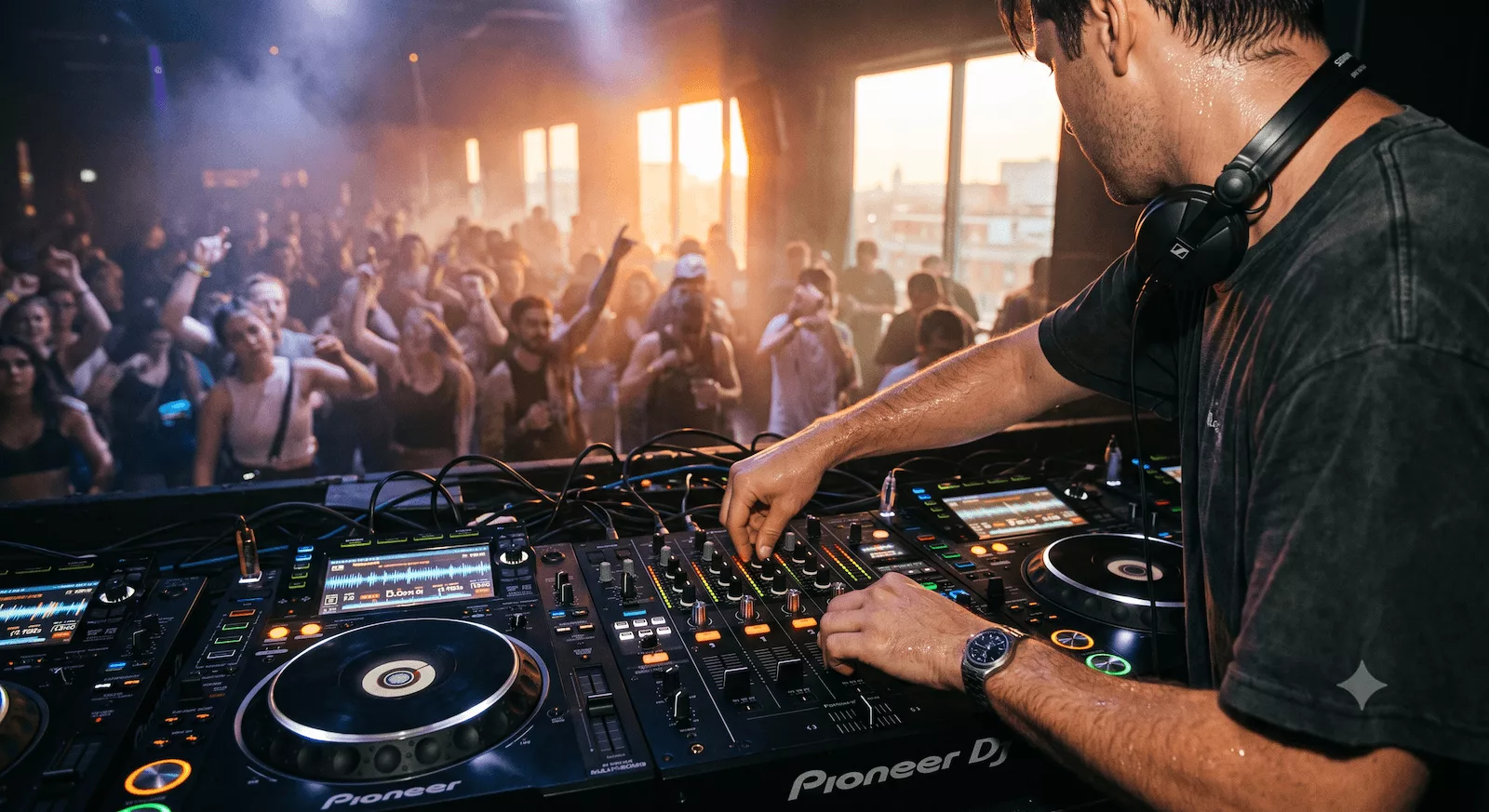
I’ve spent a couple of decades behind the decks or tangled up in studio cables, and I’ve found that the real DJ magic isn’t about the size of your record collection. It’s about how you stitch those tracks together. DJ transitions are the secret sauce: they shape the rhythm of the night, build tension, drop it like it’s hot, and flip a forgettable set into a dancefloor memory that lingers long after the lights come up.
The way a DJ moves from groove to groove – the slow tease, the hands-in-the-air blast, the cheeky pause that leaves you breathless – decides whether you’re just playing songs or conducting a joyful, communal journey.
Whether you spin wax, swing on the dancefloor, or just obsess over playlists in your kitchen, a peek behind the curtain of transitions reveals what truly sets dancefloor legends apart. Let’s set the mirrorball in motion.
What is a DJ Set, Anyway?
A DJ set isn’t a playlist. It’s a living, breathing narrative that lives in a single moment. The entire flow hinges on transitions: those slick, undercover moves that pull the crowd from one feeling to the next. That’s the heartbeat.
Anyone can play bangers for ninety minutes. Masters shape energy like a sculptor shapes clay, turning a series of tracks into a full-blown emotional ride—think soaring hands, collective sighs, blissed-out lows, and ecstatic peaks. In the world of dance music, where you feel changes in your bones and calves, transitions carry the crowd further than any single drop ever could.
As a wise Corona once said, ‘this is the rhythm of the night’. That’s what the DJ transition is.
Why energy transitions turn dancing into an experience
Dance music at its heart is about feeling connected. Energy transitions are your keys to four magical ingredients: holding the crowd’s gaze, dialing the tempo for mind and body, dropping in vulnerability and drama, and guiding the whole room like you’re the pied piper in a velvet suit.
If you just slam the pedal down, people fade. Ease in, build suspense, and suddenly every strobe and snare means more. True drama is about contrast, not just the high-energy hands-up moments. It’s about the chills before the drop, the recharge after the storm, and knowing when to let the crowd breathe. Iconic dance moments don’t happen by accident. They’re engineered, transition by transition.
Bicep as the sun goes down (or comes up)? Pure engineering.
The Technical Chemistry of the Booth
It’s more than pushing BPMs into the red. It’s groove chemistry: the interplay of tempo, percussion, melody, energy, and all those tricks you pick up after hours lost in dusty basement bars.
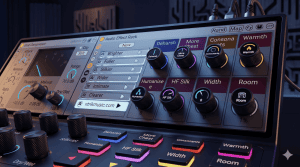
You massage the frequencies. You isolate the mid-range to let a new vocal breathe over the outgoing track’s groove, or you meticulously carve out the low-end frequencies of the incoming track, holding the bass back, until the perfect four-bar window appears.
You let anticipation stew using a high-pass filter sweep or a reverb-drenched breakdown. Take a page from Ben UFO’s marathons: the tiniest, surgical EQ twist on a rotary mixer can send a physical ripple through an entire room.
None of this is accidental. The best transitions lean on cognitive science. Our brains naturally crave surprise balanced with structure – and road-tested know-how. Only the brave pull off a three-minute analog tease without clearing the floor. Peer-reviewed research into auditory mechanics proves that our neurological pleasure centres fire rapidly when structural musical expectations are artfully delayed and then satisfied.
The Separation of Curation and Performance: An algorithm can match tempos and keys, and a streaming playlist can crossfade tracks. But an algorithm cannot feel the collective energy of a room at 4:00 AM, nor can it purposefully withhold a bassline for sixteen extra bars just to turn anticipation into pure ecstasy. The transition is where automated curation ends and human storytelling begins.
No DJ survives on technical chops alone. Legends win trust by syncing with the crowd’s micro-signals: a cluster of dancers losing steam, quick glances to the bar, the sudden hush before sunrise. If it’s 4 a.m. and everyone’s feet are begging for relief, a master selector drops a drawn-out breakdown. The kind that holds the floor in suspense before relighting the fuse.
The Transition Matrix: Subcultural Coding
Every dancefloor speaks its own distinct architectural language. The way you blend a record must respect the heritage and spatial boundaries of the room you are playing.
| Environment / Subculture | Transition Style | Technical Core | Emotional Objective |
| Hypnotic Underground (e.g., Berlin Techno / Deeper House) | The Macro Tease | Long-form, multi-minute phase blends; surgical isolator EQ carving. | Subconscious hypnosis; smooth, unbroken flow where tracks lose individual identity. |
| Big-Room / Festival (e.g., Ibiza Main Stages / EDM) | The Micro Pivot | Kinetic filter cuts, sudden 4-bar vocal drops, rapid rhythmic resets. | Immediate, visceral call-and-response; high-impact adrenaline resets for large crowds. |
Three iconic transitions that rewrote the rules
- Larry Levan and the art of the long build (Paradise Garage magic)
Larry Levan wasn’t about chasing every obvious climax. His legendary Paradise Garage sets thrived on patience. Picture him holding an acoustic breakdown for what felt like an eternity, teasing the room with percussive tape echoes, then dropping the keys at the precise millisecond the room reached a fever pitch. Tracks like First Choice’s “Let No Man Put Asunder” weren’t just played; they were stretched, twisted, and elevated to the level of ritual. Levan’s marathon transitions remain the absolute blueprint for DJs who value the journey as much as the destination. - Sasha & John Digweed
Sasha and John Digweed’s Renaissance era didn’t just set a mood—it built an entire landscape of progressive house tension. Forget predictable, cookie-cutter drops. In 1994, executing these transitions required immaculate manual precision. Mixing analog-style on Numark mixers without modern sync buttons, digital loops, or visual waveform screens, they relied entirely on raw auditory intuition to lock vinyl phases together for minutes at a time. Their long, undulating blends and subtle EQ shifts treated the night as a continuous, organic story rather than a disjointed playlist. - Carl Cox
No one handles a gigantic festival crowd quite like Carl Cox. He treats a sea of thousands like a live symphony, utilizing hyper-kinetic micro-transitions—blink-and-you-miss-it breakdowns, double-drop bassline swaps, and razor-sharp filter play. He keeps thousands moving without burning them out by reading the room and knowing exactly when to push or pull back. These high-impact transitions multiply the big moments, stringing highlight after highlight together while maintaining impeccable momentum.
The Debate: Is a Flawless Mix Always Better?
While the industry often treats the seamless, invisible blend as the holy grail of DJing, there is an argument to be made for the power of the jarring disruption. When a set becomes too smooth, it risks becoming sterile—sonic wallpaper that lulls the brain into a safe, predictable rhythm.
Look to the early history of Hip-Hop turntablism or the raw, jagged edges of post-punk and industrial selectors. An abrupt, unquantised cut, a sudden drop into complete silence, or a radical, unexpected genre clash shocks a complacent dancefloor awake. It injects a sense of danger and human error back into the booth. The truly legendary sets often live in the friction between absolute technical perfection and chaotic, raw disruption.
The Essential Listening Room
To truly understand how these theories translate into physical energy, you have to close your eyes and listen to the architecture of these classic sets from legends Sasha & John Digweed, Carl Cox and Solomun:
Sasha & John Digweed — Live at Renaissance: The Mix Collection (1994): Listen closely to Disc 1 as the mixes stretch across vast spaces. This is the definitive masterclass in transitions that last longer than most modern tracks, blending underground progressive gems into a singular, fluid narrative flow.
Solomun — Boiler Room DJ Set (2015): Watch this landmark video performance to observe real-time crowd reading in action. Pay attention to how Solomun uses deep, melodic house transitions to constantly recalibrate the energy of the densely packed booth surrounding him, turning structural delays into massive physical releases.
Carl Cox — Space Ibiza Closing Set (2016): A masterclass in high-velocity festival energy. Every transition is tight, kinetic, and engineered for a sea of hands, demonstrating how to maintain absolute momentum across a multi-hour marathon.
DJ Transitions: the secret sauce of every shared groove
Energy transitions pop up wherever you want to bring a crowd on a journey, from cinematic editing to storytelling slams. It’s not unique to DJing in any way. Managing energy is about pacing, holding back when every nerve says to surge, or hitting the gas when you know everyone can handle it. At the core is profound empathy, or more accurately, the ability to read the collective soul of the room.
DJ are not just selectors or button-pushers; we are the storytellers fluent in the rhythm of the collective mood. The best moments where tracks slide together smoothly are forged from decades of dancefloor contact and crate-digging obsession.
I’ll say this: there’s nothing that gives a set its spark like a DJ transition that lands at the exact right moment.
Learn the craft, bend the moments, and don’t be afraid to set hearts racing before pulling back for a deep, collective breath. That push and pull? That is the magic, and it’s why we keep coming back, seeking the next euphoric drop, the next shared high, the next sunrise anthem.
Never underestimate the power of a great transition. That’s where the groove starts. And the stories never end.